Starting an online store in Saudi Arabia can cost almost nothing if you build a very simple store yourself, or tens of thousands of Saudi riyals if your business needs professional design, bilingual content, custom functionality, integrations and a large product catalogue. That is why “How much does an e-commerce website cost?” rarely has one correct answer.
A better question is: what type of online store does your business actually need, and what should you budget to build and operate it properly? For many small and growing Saudi businesses, a realistic professional project falls somewhere between SAR 8,000 and SAR 30,000+, while simple hosted-platform stores cost much less and complex custom platforms can cost considerably more. These are planning ranges, not fixed quotations. Your actual cost depends on the platform, design, product count, integrations, languages, payment methods and shipping requirements.
E-commerce Website Cost in Saudi Arabia: Quick Answer
Here is a practical way to think about the different levels of e-commerce development.
| Type of store | Approximate planning budget | Best suited for |
|---|
| DIY store on Salla, Zid or similar | Platform fees + optional theme/apps/setup | Testing an idea or a very small business |
| Professionally configured hosted store | SAR 3,000–SAR 12,000+ | A small business wanting a professional launch without extensive custom development |
| Professional WooCommerce store | SAR 8,000–SAR 30,000+ | A business needing greater ownership, flexibility and customization |
| Advanced e-commerce website | SAR 30,000+ | An established brand with integrations, a large catalogue or advanced workflows |
| Fully custom e-commerce platform | Custom quotation | A business with unique or complex operational requirements |
A store selling 20 products with one shipping company and a standard checkout is very different from a bilingual store with 5,000 products, ERP synchronization, several warehouses and customer-specific pricing. Use the table above for initial budgeting, not as a fixed quotation.
Why Do E-commerce Website Prices Vary So Much?
An e-commerce website is much more than a homepage and some product cards. Behind the storefront, it may need to manage products and variations, inventory, online payments, VAT, orders, customers, shipping, returns, discounts, invoices, analytics, notifications, stock synchronization, multilingual content, SEO, and accounting or ERP integrations. Two stores can look almost identical to a customer while being completely different underneath. The biggest mistake is choosing a budget based only on how the website looks; the more important question is what the website needs to do for the business.
Option 1: Building Your Store With Salla
Salla is one of the major e-commerce platforms built for merchants in Saudi Arabia and the wider region. As of September 2026, its published annual plans are:
| Salla plan | Current platform price |
|---|
| Basic | Free |
| Plus | SAR 990/year |
| Pro | SAR 2,990/year |
Salla states its plans support unlimited products and orders, while online payments, customization and more advanced capabilities depend on the package selected. It can be a good fit if you operate primarily in Saudi Arabia, want to launch relatively quickly, prefer not to manage WordPress hosting yourself, and have fairly standard e-commerce requirements.
One thing to keep in mind: the subscription is not the whole project cost. You may still pay separately for professional store setup, custom design, product entry and photography, bilingual content, SEO, analytics setup, integrations and ongoing management. The platform fee is only one part of the budget.
Option 2: Building Your Store With Zid
Zid is another Saudi-focused e-commerce platform. As of September 2026, its published pricing is:
| Zid plan | Current platform price |
|---|
| Starter | Free |
| Rise | SAR 990/year |
| Growth | SAR 2,990/year |
| Professional | Custom quotation |
Each tier adds progressively more functionality, with the higher levels aimed at growing and larger operations. Zid can suit a business that values Saudi-focused commerce tools, integrated payments and shipping, POS functionality, and less responsibility for managing the underlying platform. As with Salla, keep the subscription cost separate from the cost of a properly designed and configured store.
Option 3: Shopify
Shopify is one of the world’s largest hosted e-commerce platforms, useful for businesses with international ambitions or that want access to its large app ecosystem. As of September 2026, Shopify’s Saudi pricing page lists annual-billing rates starting from:
| Shopify plan | Annual-billing rate |
|---|
| Basic | US$19/month |
| Grow | US$54/month |
| Advanced | US$299/month |
Shopify also charges extra for third-party payment providers: 2% on Basic, 1% on Grow and 0.6% on Advanced at the time of writing, which matters more as sales volume grows. Depending on the project you may also need a paid theme, apps, development and customization, product migration, multilingual setup and integrations — a relatively inexpensive subscription can become a substantially larger operating expense once a store depends on several paid apps.
Option 4: WordPress + WooCommerce
WooCommerce works differently. It is free and open source, runs on WordPress, and has no required monthly platform subscription or revenue share. That does not make a professional WooCommerce store free, though: WooCommerce’s own guidance gives typical hosting costs of roughly US$25–US$350 per month depending on requirements, while individual paid extensions run around US$29–US$299 per year. A full project may also include the domain, WordPress setup, custom design, product architecture, payment-gateway setup, shipping and tax configuration, security, backups, caching, SEO and ongoing maintenance — which is why a professionally built WooCommerce store can cost more up front than simply opening a hosted-platform account.
The main attraction is control: greater ownership of the website, flexible design, deep WordPress integration, custom functionality, control over hosting, and fewer platform-level restrictions. That flexibility comes with responsibility — someone has to maintain WordPress, plugins, security, backups and performance. For the right business that trade-off is worthwhile; for another, a managed platform such as Salla, Zid or Shopify may make more sense.
Option 5: Fully Custom E-commerce Development
A fully custom platform is not automatically the “best” option — it is the right option only when your requirements genuinely cannot be handled efficiently by standard systems. Examples include unusual marketplace models, complex multi-vendor setups, custom B2B ordering, customer-specific pricing, multi-step approval workflows, advanced ERP integration, several warehouses with custom stock logic, or highly customized checkout flows. Custom development can start at tens of thousands of riyals and rise significantly with scope. A small business selling 30 straightforward products generally does not need a custom platform just because it sounds more advanced — technology should fit the business, not the other way around.
What Actually Determines the Cost of an E-commerce Website?
Several factors matter more than the platform alone.
Number of products. A store with 20 products is far easier to prepare than one with 5,000. Large catalogues need structured imports, categories, variations, attributes, filtering, SKU management and inventory sync — product data preparation can become a major part of the project on its own.
Custom vs. template design. Changing a theme’s logo and colours is far cheaper than a genuinely custom homepage, product page, cart and checkout experience. Custom design pays off most when brand perception and conversion really matter.
Arabic and English. A properly bilingual Saudi store needs more than translated sentences: RTL layouts, localized interface text, translated SEO metadata, separate URLs, hreflang, bilingual navigation and Arabic-compatible fonts, all tested on both language versions.
Payments. Complexity depends on which methods you support — Mada, Visa, Mastercard, Apple Pay, bank transfer, cash on delivery, buy-now-pay-later — and which gateways are available for your setup. Providers also charge transaction fees worth comparing alongside integration cost.
Shipping. This can be simple or surprisingly complex: fixed rates, free-shipping thresholds, location-based pricing, courier integration, label creation, tracking, same-day Riyadh delivery, nationwide delivery, or international shipping.
Inventory and ERP integration. A store gets significantly more complicated once inventory needs to sync with physical stores, warehouses, POS systems, ERP or accounting software, or marketplaces — these integrations can become one of the largest line items in an advanced budget.
Custom features. Anything outside a platform’s normal functionality — product configurators, customer portals, quotation systems, unusual pricing calculators, subscriptions, booking, membership tiers, wholesale pricing — should be costed individually.
E-commerce Costs Business Owners Often Forget
The initial development quotation is not the whole budget. A sustainable online store also carries ongoing costs: hosting or platform subscription; domain renewal; WordPress maintenance (updates, backups, security monitoring); premium apps and plugins that accumulate over time (marketing, SEO, filters, invoicing, inventory, email, integrations); product photography, since good products with poor images undermine an otherwise professional store; original product descriptions, since copied supplier text creates weak content and little search value; ongoing SEO, since launching a store does not mean Google will rank its products automatically; broader marketing beyond the website itself (ads, content, email, promotions); and payment-processing fees, where small per-transaction differences add up at scale. Calculate the annual software and running cost, not just the launch cost.
Saudi Arabia-Specific Requirements to Consider
An online store operating in Saudi Arabia should not be planned purely as a technical project — there are regulatory, taxation and consumer-protection considerations too.
Saudi E-Commerce Law. Saudi Arabia has an E-Commerce Law and implementing regulations overseen by the Ministry of Commerce. The Ministry provides an e-store compliance guide and states that online merchants should display key business and contact information and comply with requirements around consumer rights, advertising and privacy. It has also stated that businesses engaging in e-commerce activities need appropriate commercial registration or applicable freelance licensing.
VAT. For VAT-registered persons in Saudi Arabia, the standard rate is currently 15% where applicable — your store setup needs to handle this correctly.
Electronic invoicing (Fatoorah). ZATCA’s e-invoicing requirements roll out in two phases: Phase 1 requires generating and storing compliant electronic invoices; Phase 2 involves integration with ZATCA’s Fatoora platform, introduced progressively in waves, with targeted taxpayers notified at least six months before their integration date. Not every new store needs the same Fatoora integration on day one — the correct requirement depends on the business and its tax status.
This section provides general website-planning information, not legal or tax advice. Always verify current requirements with the relevant Saudi authorities or a qualified professional.
Three Example E-commerce Budgets
Scenario 1: a new Saudi startup. 20 products, Saudi customers only, one language initially, standard shipping and payments, no ERP, ready-made design. A hosted system such as Salla or Zid is the sensible choice here — keep the platform cost low and put the budget into setup, branding, product content, photography, payment setup and launch marketing. There is little reason to spend SAR 50,000 on custom development before the business has validated demand.
Scenario 2: a growing Saudi brand. Arabic and English, 300 products, custom brand design, professional categories, payment integration, several shipping rules, analytics, an SEO foundation and ongoing support. This is where a professional WooCommerce build or a professionally customized hosted platform tends to make sense, with a planning budget roughly in the SAR 8,000–SAR 30,000+ range depending on scope. What matters is not hitting a specific number but understanding exactly what is included.
Scenario 3: an established company. Thousands of products, several branches, multiple warehouses, ERP, customer accounts, sophisticated stock sync, advanced reporting, bilingual content and custom business rules. This is no longer a website-design project — it is a commerce-systems project. A budget of SAR 30,000+ can be entirely reasonable here, and sophisticated custom implementations can go substantially higher. The quotation should be based on documented requirements, integrations and workflows.
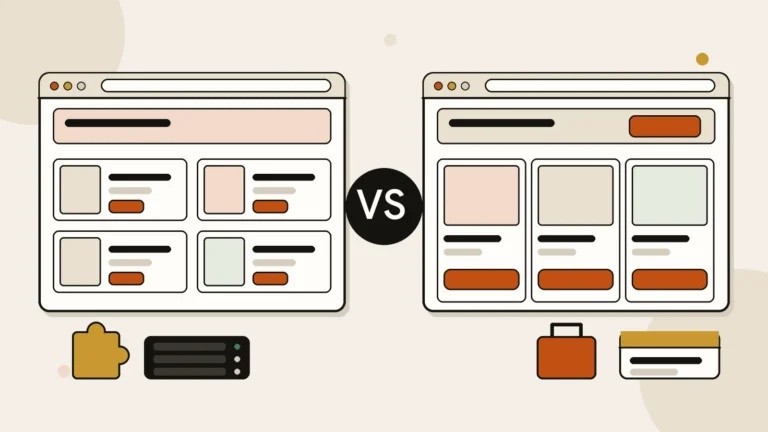
Salla vs Zid vs Shopify vs WooCommerce: Which Should You Choose?
There is no universal winner.
| Platform | Often a good fit when… |
|---|
| Salla | You want a Saudi-focused managed platform and a relatively fast launch |
| Zid | You want Saudi-focused e-commerce with integrated operational features |
| Shopify | You value a global ecosystem and potential international expansion |
| WooCommerce | You want greater website ownership, WordPress flexibility and deep customization |
| Custom development | Your requirements genuinely cannot be handled efficiently by established platforms |
Common mistake
Do not choose a platform purely on which has the cheapest monthly subscription — think about where the business needs to be in two or three years. Migrating thousands of products, customer records, URLs and workflows later is considerably harder than picking the right foundation at the start.
When Is Paying More for an E-commerce Website Worth It?
Paying more makes sense when it solves an actual business problem: reducing manual admin, connecting inventory automatically, creating a better mobile buying experience, handling thousands of products efficiently, supporting Arabic and English properly, improving checkout usability, cutting repetitive staff work, or integrating essential business systems. Paying more just to make a project sound “premium” is not a good investment — and always choosing the cheapest possible store can become expensive later if it cannot support the business as it grows. The goal is appropriate technology at an appropriate budget.
Questions to Answer Before Requesting an E-commerce Website Quote
- What will you sell?
- Approximately how many products will the store contain at launch?
- Do products have variations such as size, colour or weight?
- Do you need Arabic, English or both?
- Which payment methods do you need?
- Where will you deliver — Riyadh, all of Saudi Arabia, or internationally?
- Do you already use an ERP, POS or inventory system that needs to connect to the store?
Answering these before your first call means any quote you receive will actually be comparable to the next one — and it is exactly the starting point I work through with clients before proposing a platform or a budget.


 E-commerce & Online Selling
 Business Websites
 Business Websites