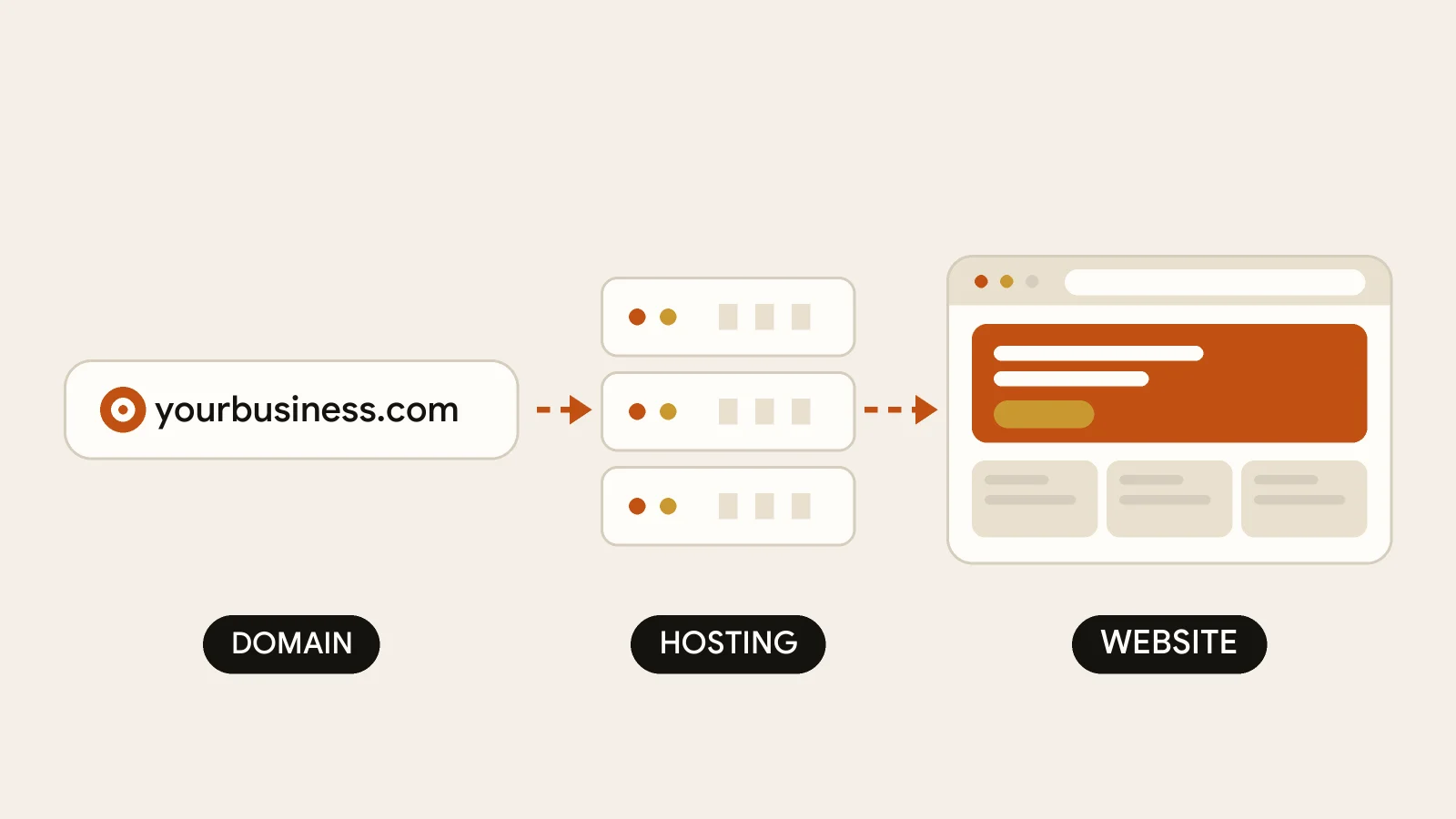
Domain vs hosting vs website sounds like jargon, but the difference is simple. A domain is your website’s address, hosting is the rented computer space where the site’s files live, and the website is the pages your visitors actually see. A business website needs all three, and they are often bought from different companies, which is exactly where owners get confused.
This guide is for business owners in Saudi Arabia who are about to pay for a website, or who already have one and are not sure what they are paying for. I will explain each part in plain words, show how they connect, and point out the few mistakes that cost people their site. If you want the bigger picture first, start with my step-by-step guide to starting a business website.
Key takeaways
- A domain is the address, for example yourbusiness.com. Hosting is where the files are kept. The website is what visitors see.
- You rent a domain for a set period, usually a year at a time. If it expires, your site and your business email can stop working.
- Hosting is the always-on computer that delivers your pages. Weak hosting can make a good website feel slow and unreliable.
- Keep the domain registered in your own name and your own account, even if someone else builds the site.
- Website builders bundle all three into one subscription. With WordPress or a custom site you usually buy them separately.
The shop picture in one minute
Think of a shop. The domain is the address on the sign above the door, the thing you tell customers so they can find you. The hosting is the plot and the building the shop stands in. You rent it, and it has to stay open and connected. The website is the shop itself: the shelves, the counter, the products and the prices.
A customer needs all three. A sign with no building leads nowhere, and a building with no sign is one nobody finds. Here is how the parts line up.
| Part | What it is | Shop comparison | Where you get it | How you pay |
|---|
| Domain | Your web address, such as yourbusiness.com | The address on the sign | A domain registrar | A renewal, usually yearly |
| Hosting | A computer that stores your site and sends it to visitors | The building and land | A hosting company | A monthly or yearly plan |
| Website | The pages, text, photos, forms and design | The shop itself | A developer, an agency, a website builder, or you | Once to build, then upkeep |
Domain: the address people type
A domain name is a human-readable address for your website. Behind every website sits a string of numbers called an IP address, which is how computers find each other. Mozilla’s web documentation explains that these numbers are hard for people to remember and can change over time, so the domain name stands in for them.
You rent a domain, you do not buy it
This surprises many owners. The same Mozilla guide says you cannot buy a domain outright. You pay to use it for one or more years, and you can renew it. Companies called registrars sell domains, and they ask for real contact details. The email on that record is where your renewal warnings are sent.
ICANN, the organisation that coordinates the domain system, says registrars must send at least two reminders before a generic domain such as a .com expires, roughly a month and a week ahead. If the domain is deleted, there is normally a 30-day redemption period in which you can restore it, usually for an extra fee. Websites and email tied to the domain can stop working during that time.
3parts every working website needs: a domain, hosting and the website itself
2minimum renewal reminders registrars must send before a generic domain expires (ICANN)
30 daysredemption period for a deleted generic domain, with a restore fee (ICANN)
So a missed renewal is not a small problem. Customers see an error page, and mail sent to your business address can bounce.
A note on .sa domains
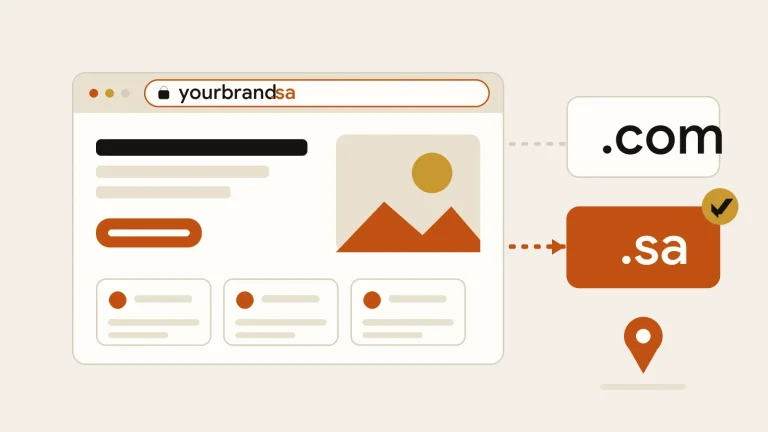
The Saudi Network Information Center, NIC.sa, runs Saudi domain services under the Communications, Space and Technology Commission. It says individuals and non-government organisations register a .sa domain through a licensed registrar, and that the eligibility rules are in its regulations, so read those before you choose. Which ending to pick is a separate decision. Either way, the domain is only the address. It does not change what hosting or a website are.
How a visitor reaches your website
The three parts meet within a second or two every time someone opens your site. A system called DNS, short for Domain Name System, connects them. Cloudflare compares it to a phone book: it turns the name a person types into the number a computer needs.
- A customer types your domainOr taps a link from Google, Instagram or WhatsApp.
- The browser asks DNSDNS looks up which server your domain is connected to.
- DNS answers with an addressThat address points to your hosting company’s computer.
- The hosting computer sends your pagesText, photos and forms travel to the customer’s phone.
- The website appearsAll of this usually takes a moment.
This is also why a new domain, or a move to new hosting, can take a while to work everywhere. Mozilla notes that DNS servers around the world can take a few hours to receive new information because of caching. If you move a site, expect it to look different on two phones for a short time and do not panic.
Hosting: where your website lives
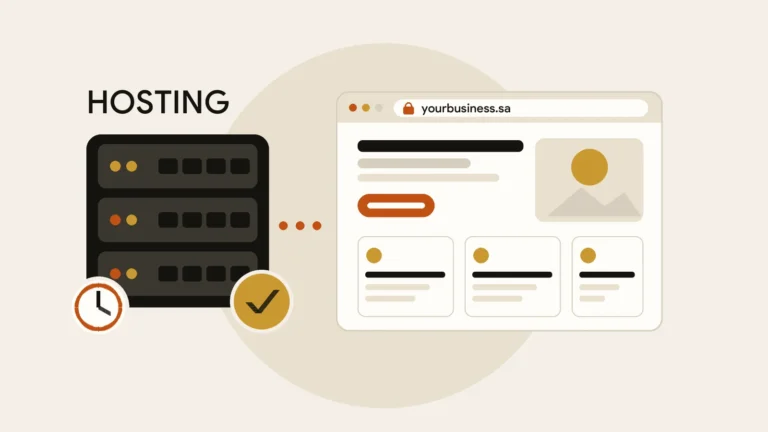
Hosting is a computer, called a server, that stores your website’s files and stays connected to the internet all day so visitors can open your pages at any hour. You could technically keep a site on your own laptop. Mozilla points out that a dedicated server is more convenient because it stays online, keeps the same address and is looked after by a provider. That is why businesses pay a hosting company.
Many business sites, including the WordPress sites I build, are dynamic. Instead of sending fixed files, the server builds each page when it is requested, using a database that holds your text and settings. That takes more than a simple file store, which is one reason hosting quality matters.
Cheaper plans usually share one server between many websites. Busier or larger sites often need more power or a plan that is managed for you. Before buying, I would check where the servers are, how backups work, whether support is available in a language and at hours you can use, and what the renewal price is after the first year. I will not quote prices here, because they vary widely. My guide to small business website costs in Saudi Arabia explains what drives them.
Tip
Ask the hosting company in plain words: if my site goes down at night, who fixes it, and how do I get my files back? A clear answer tells you more than a list of features.
The website: the part visitors judge
The website itself is the pages, words, photos, buttons and forms. It sits on your hosting and appears under your domain. It is also the part you can change most often without touching the other two. You can redesign it, rewrite it or add an Arabic version, and the domain stays the same.
A domain is the cheapest part to look after and the most expensive part to lose.
Buying them together or separately
Website builders such as Wix, Zid or Shopify bundle the domain, hosting and website tools into one subscription. That is simple, but you work inside that company’s system. With WordPress or a custom site you normally buy the domain from a registrar and hosting from a host, and the website is built on top. Each approach has a place, and I compare them in WordPress vs website builders.
Everything with one company
- One bill and one login
- Easy to start
- Moving later can be harder
- Stopping payment can put all three at risk
Domain registered separately
- You keep the address if you change host or developer
- Hosting can be moved without losing your name
- One more login to keep safe
- Renewal dates to track
My rule is simple. The domain should sit in the business owner’s own account, with an email address the owner controls, whoever builds the site. I explain why, and what else you should hold, in who owns your website.
Common mistake
Letting the person who builds your site register the domain in their own name or on their personal email. If they disappear or change jobs, you may struggle to prove the domain is yours or to renew it.
Terms you will hear
These words come up in quotes and invoices. Here is what they mean.
| Term | Plain meaning |
|---|
| Registrar | The company you pay to register and renew your domain |
| Nameservers and DNS records | Settings that tell the internet which server your domain points to |
| SSL certificate | The padlock. It lets the site load as https with an encrypted connection, and many hosts include one |
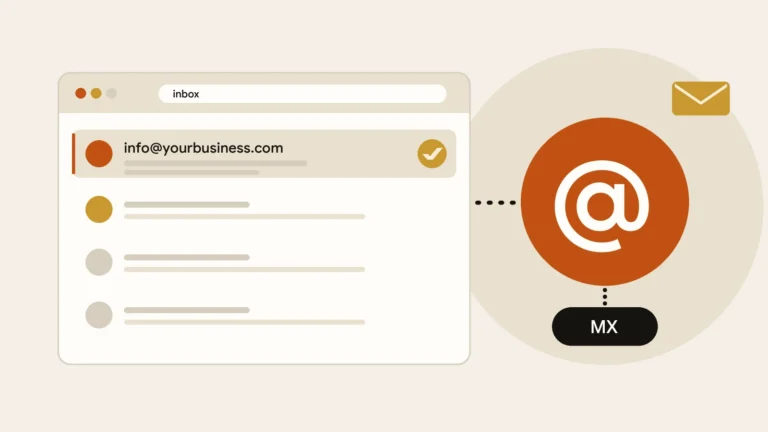
| Business email | Addresses like name@yourbusiness.com. They use your domain but are often a separate service from the website |
| Control panel | The dashboard where you manage your hosting |
| Backup | A saved copy of your site that you can restore if something breaks |
Check these before you pay
Whether you are buying new or reviewing what you already have, these seven questions cover most of the risk.
- Which company is the registrar, and is the domain in my name with my email?
- When does the domain expire, and is automatic renewal on?
- Where is the site hosted, and who do I contact if it goes down?
- Are backups included, and can I restore one?
- What will the domain and hosting cost to renew after the first year?
- Do I have my own login for both the domain and the hosting?
- Is my business email part of the hosting or a separate service?
Tip
Put the domain expiry date in your calendar with a reminder a month ahead, and make sure the registrar’s emails do not land in your spam folder.
If you would like me to look at what you have today, or explain a quote you have received, you are welcome to get in touch through the contact page. I will tell you plainly which parts you need and which you do not.
References
Official and documentation pages change over time, so check the linked pages for their current wording.

 Business Websites
 Business Websites
 Business Websites